

Remember not to mix excessively warm and excessively cool light sources, otherwise, skin tone discrepancies and uneven lighting will occur. If one bathroom vanity lamp is too yellow and another is too white, it will cause uneven skin tones reflected in the mirror.

Referring to the International Electrotechnical Commission (IEC) standards for bathroom zone classification: Most home vanities are located in Zone 2 or the dry zone. An IP44-rated bathroom vanity light is both economical and safe, fully meeting daily usage needs.
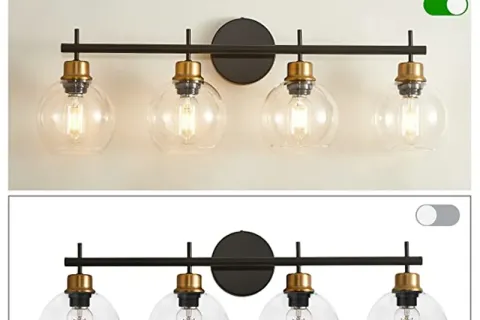
A basic and widely used rule of thumb is: Choose a light fixture that is approximately 75% the width of your vanity and install it directly above the mirror, about 75 to 85 inches above the mirror. In other words, assuming your vanity is 48 inches wide, the ideal bathroom vanity light should be around 36 inches wide.
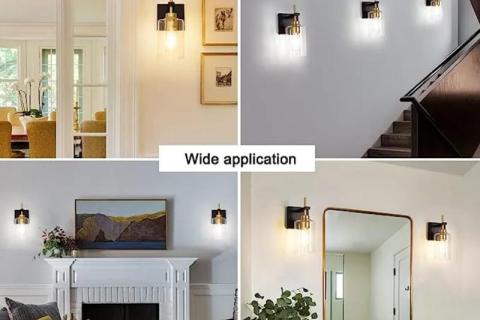
• For mirrors less than 60cm wide, one symmetrical bathroom vanity light fixture can be installed. • For mirrors between 60cm and 120cm wide, two symmetrically arranged vanity lamps are recommended. • For mirrors exceeding 120cm or for vanities used by two people, consider three or more light fixtures or an integrated front light strip design.

Yes, but certain installation principles and conditions must be met. From a lighting design perspective, installing bathroom vanity light fixtures above a mirror is a common and widely accepted lighting method. It can directly illuminate the entire face, avoiding shadows concentrated on the chin or eyes

Because bathrooms are humid environments, electrical safety is paramount for prolonged use. Choose bathroom vanity light fixtures from reputable manufacturers and with an IP44 rating or higher. They are safe for extended use.

Installing lighting above the vanity is not only a functional consideration; it also contributes to the overall comfort of the bathroom space. Effective lighting can reduce shadows and uneven lighting, creating a bright, soft glow around the mirrored area and preventing visual fatigue caused by unpleasant lighting.

The width of bathroom vanity light fixtures must first meet scientific requirements for light coverage. The human face is a three-dimensional curved surface. If the fixture width is smaller than the mirror width, uneven lighting can easily occur.

—The Necessity of Bathroom Vanity Light Fixtures! Bathroom vanity light fixtures not only enhance daily convenience but also play a vital role in aesthetics, health, and safety: 1. Improve lighting quality 2. Reduce health risks 3. Enhance quality of life 4. Ensure safety and durability
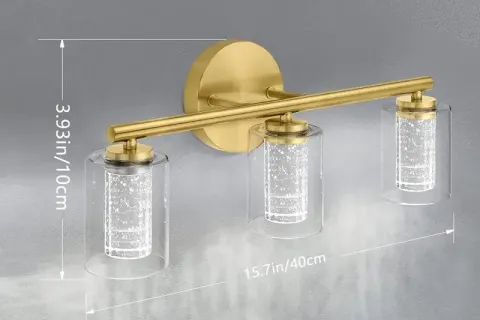
A 3000K bathroom vanity light falls within the warm light range, with a yellowish tint. 4000K approaches neutral white, falling between warm and cool tones. 5000K is cooler, corresponding to cool white light or close to natural daylight.

Bathroom vanity light size matches the length of the vanity. Common specifications are as follows: • Small lamps (30-50 cm): Prices range from approximately $40 to $100. • Medium lamps (50-80 cm): Prices generally range from $80 to $180. • Large lamps (over 80 cm): Prices can reach $200 to $400 or even higher.
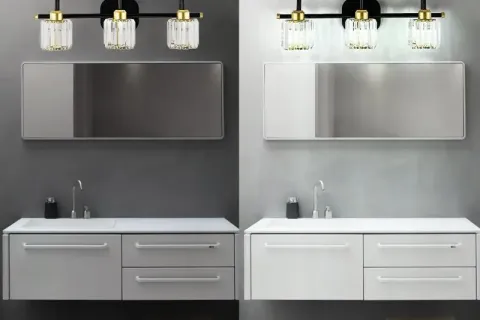
—The professionally recommended answer is: approximately 60W. This wattage does not directly refer to the LED power, but rather to the luminous flux equivalent of a traditional 60W incandescent bulb, or approximately 800 lumens. This means that only approximately 8W–12W of LED power is needed to achieve the same luminous flux as a traditional 60W incandescent lamp.